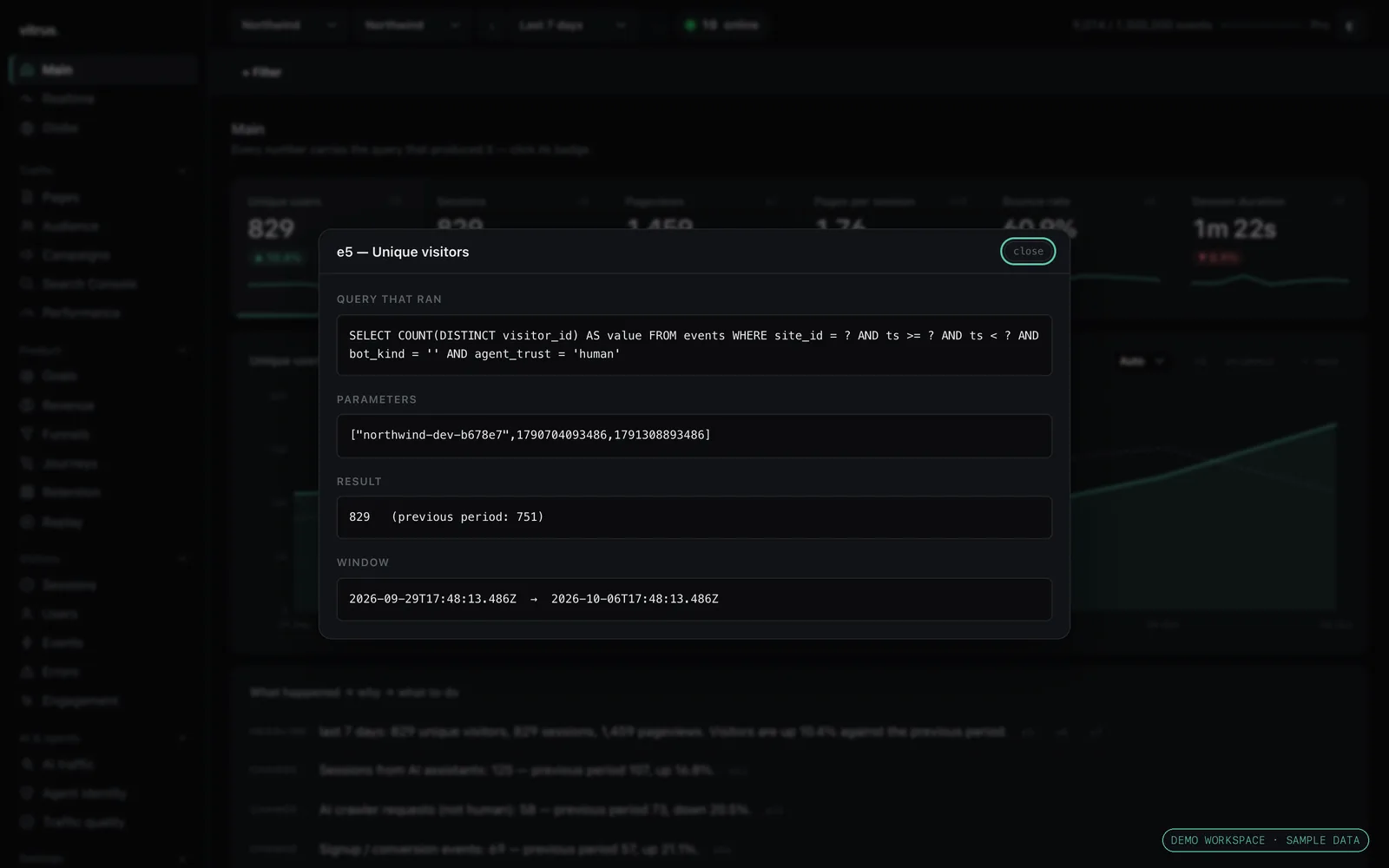
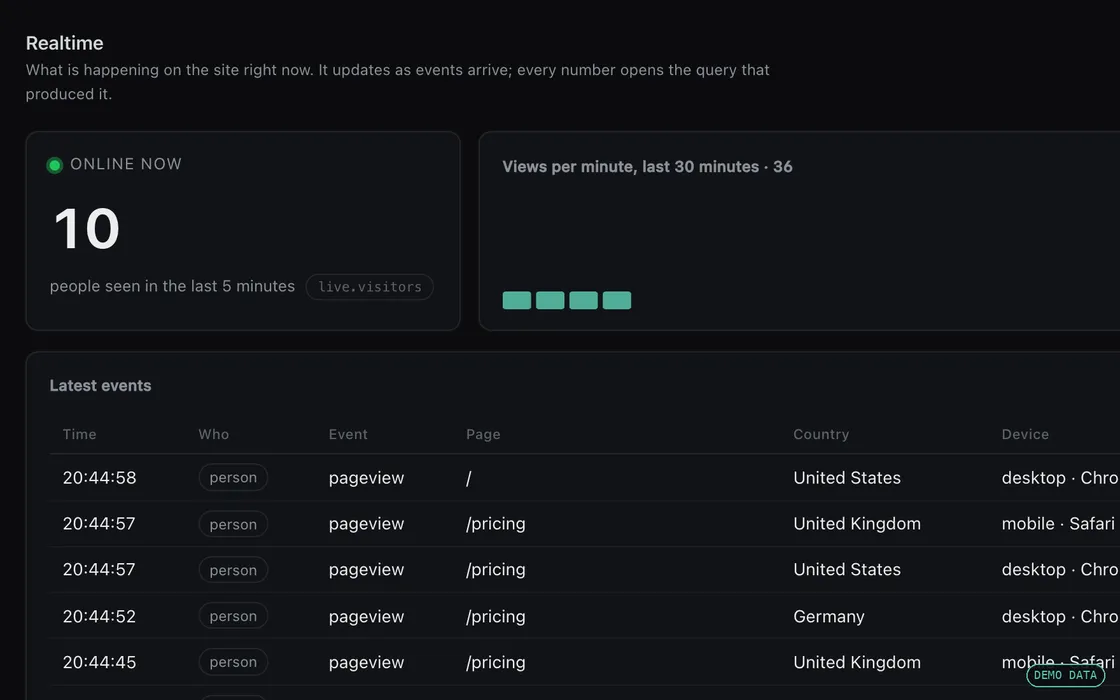
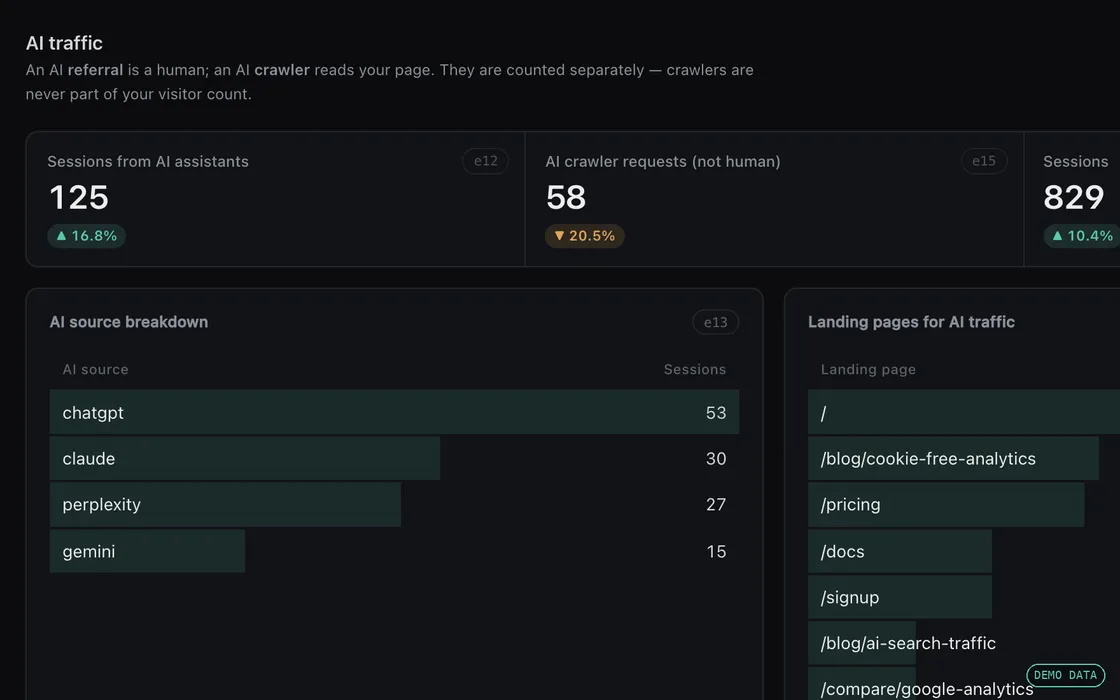
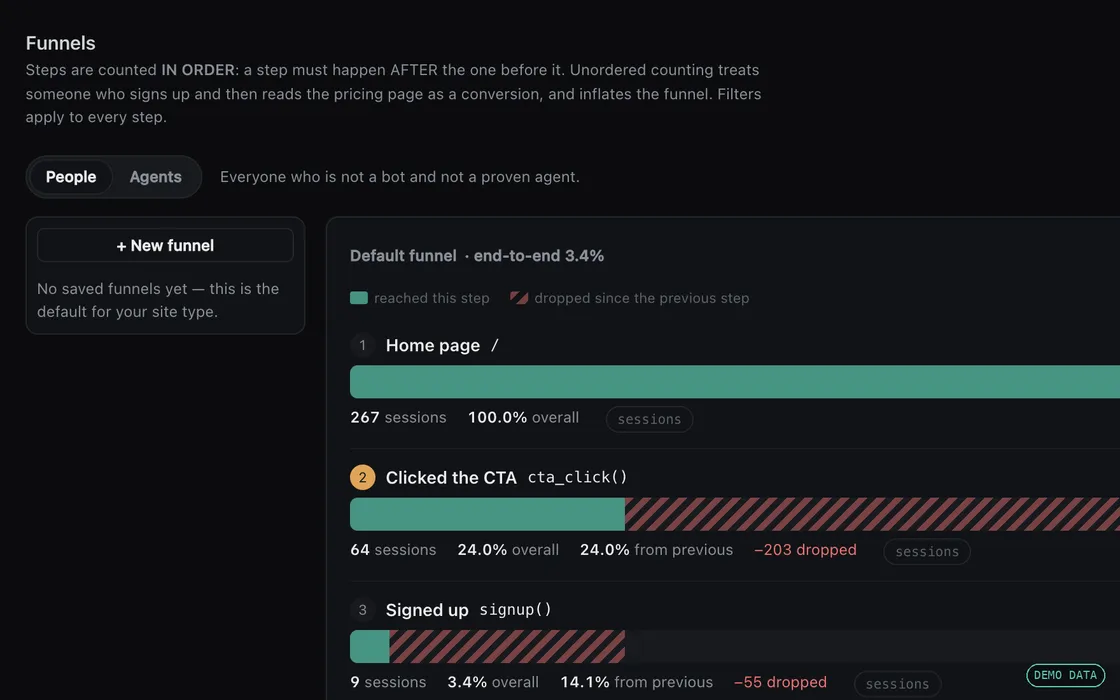
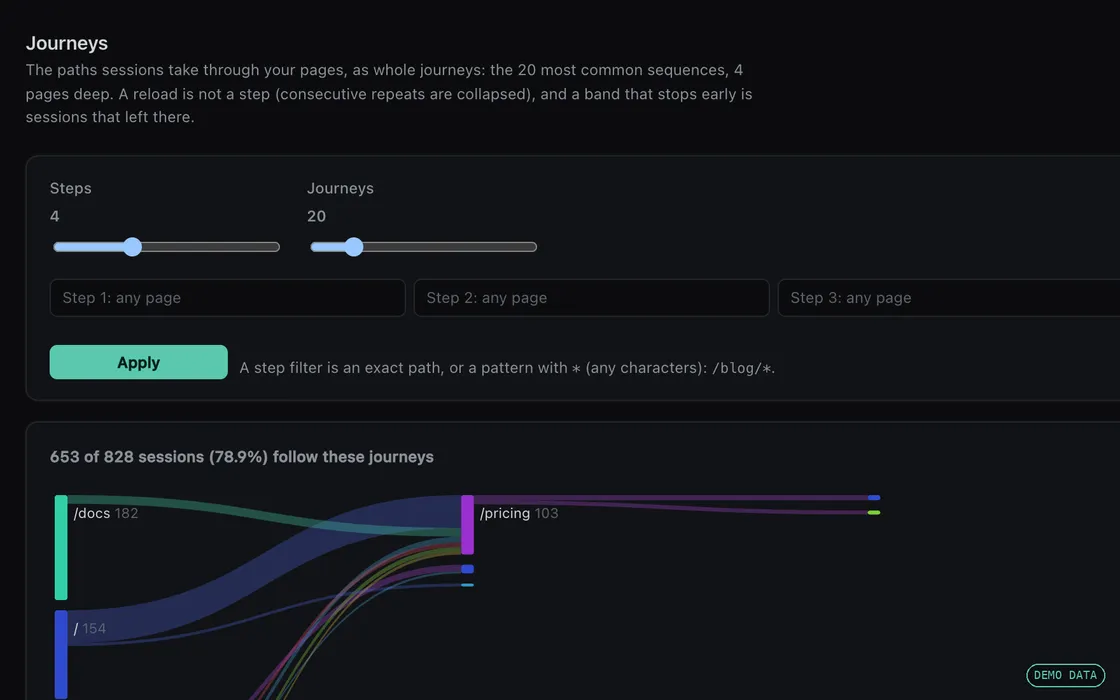
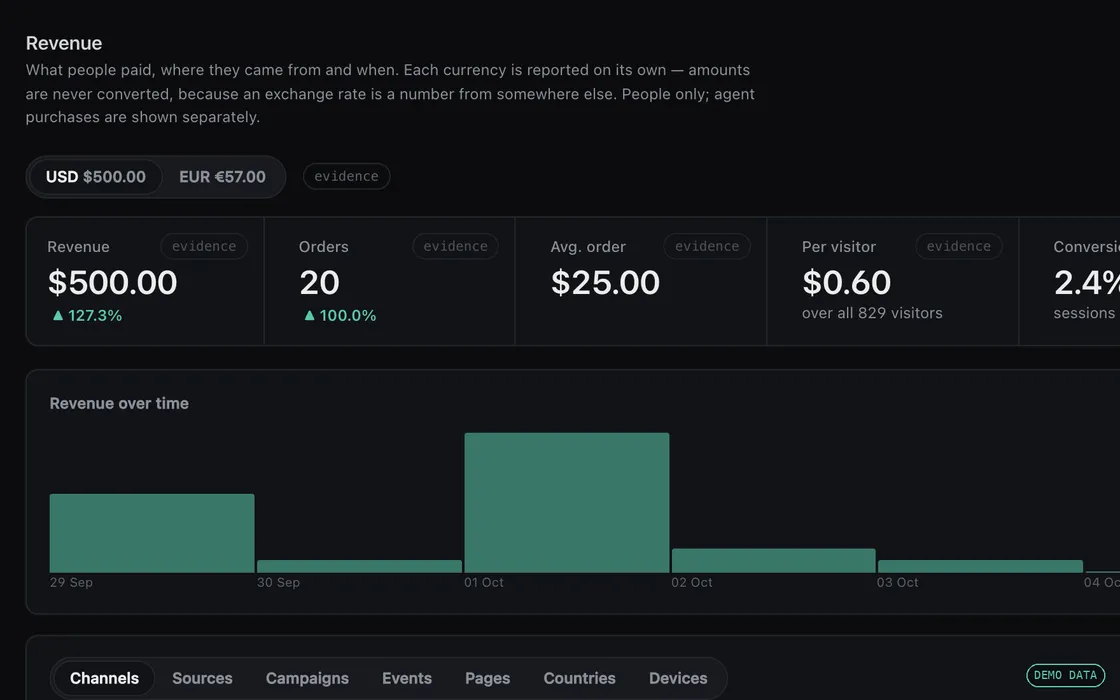
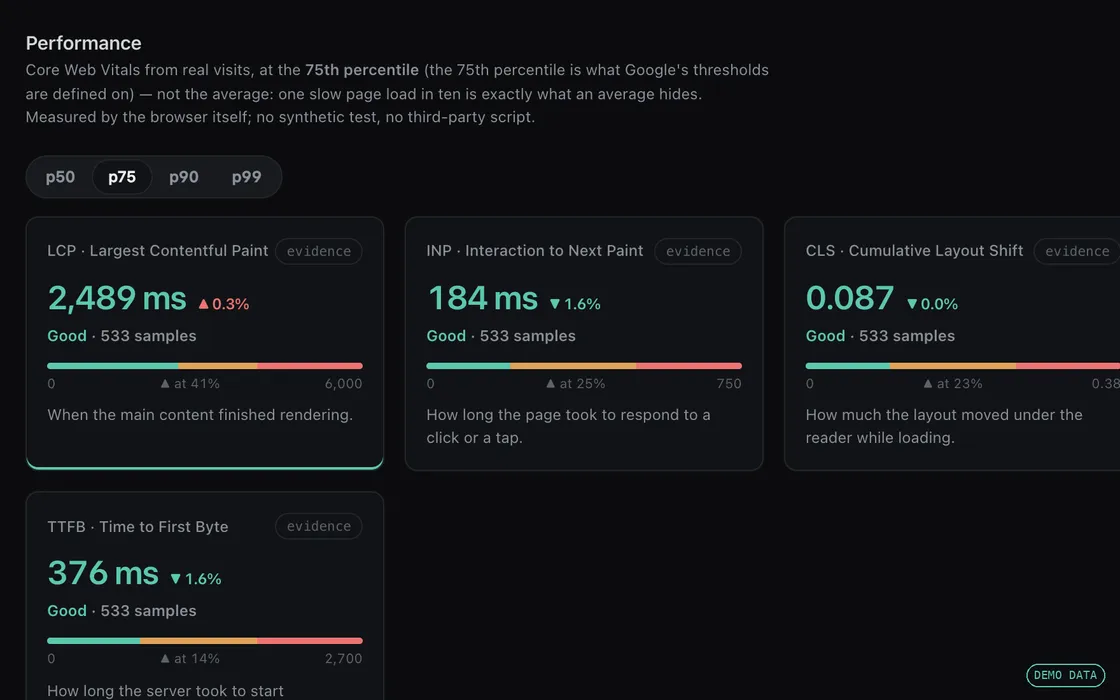
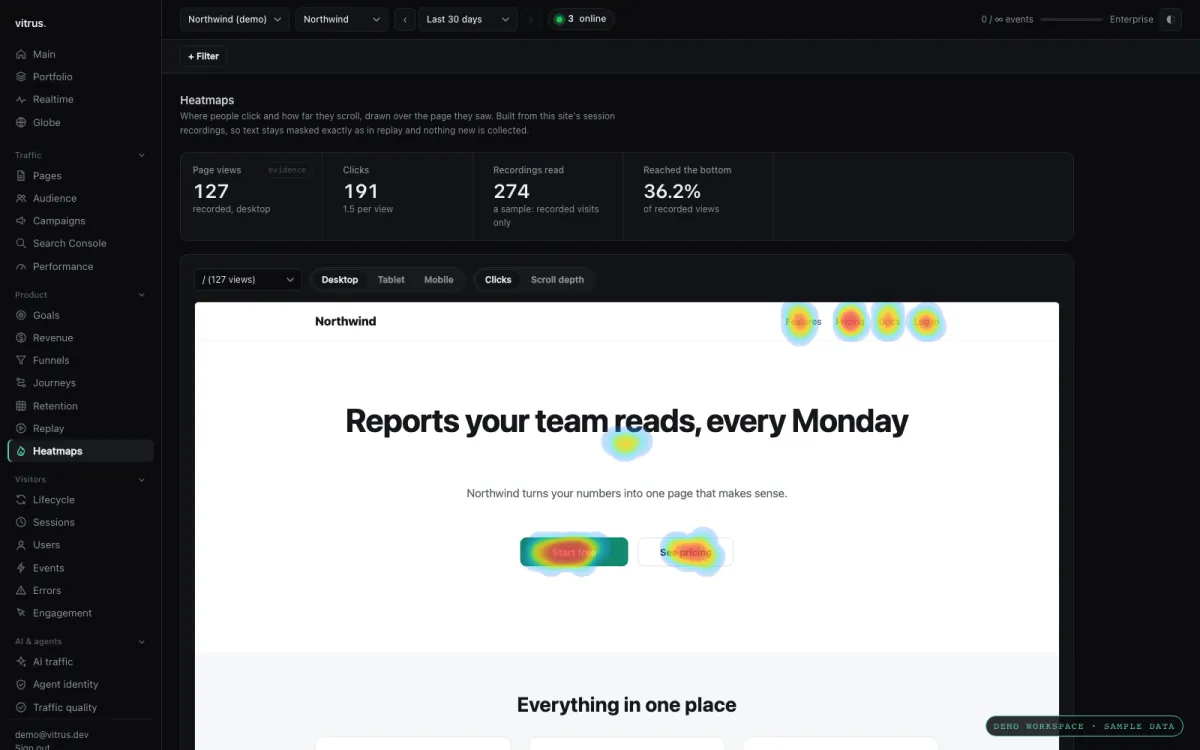
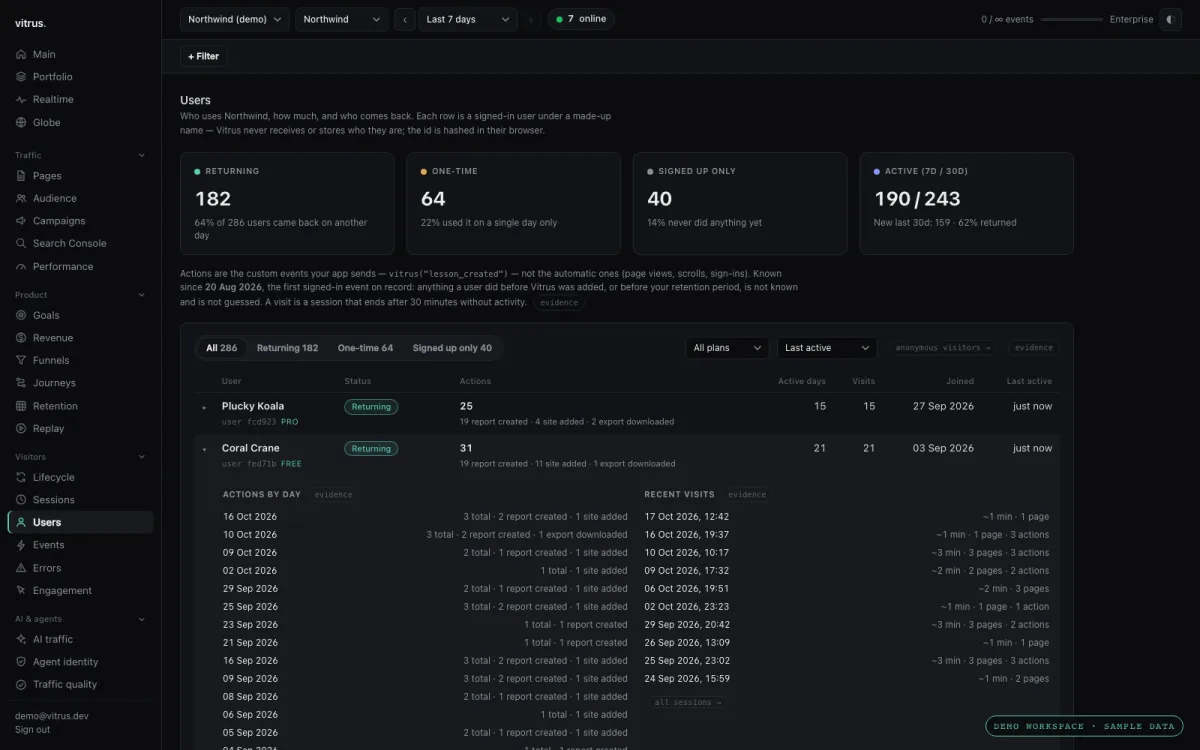
Every number opens the query that counted it — for you, or for ChatGPT and Claude over MCP.
Free plan, no card · 3.0 KB script · Apache-2.0 core · the demo needs no account
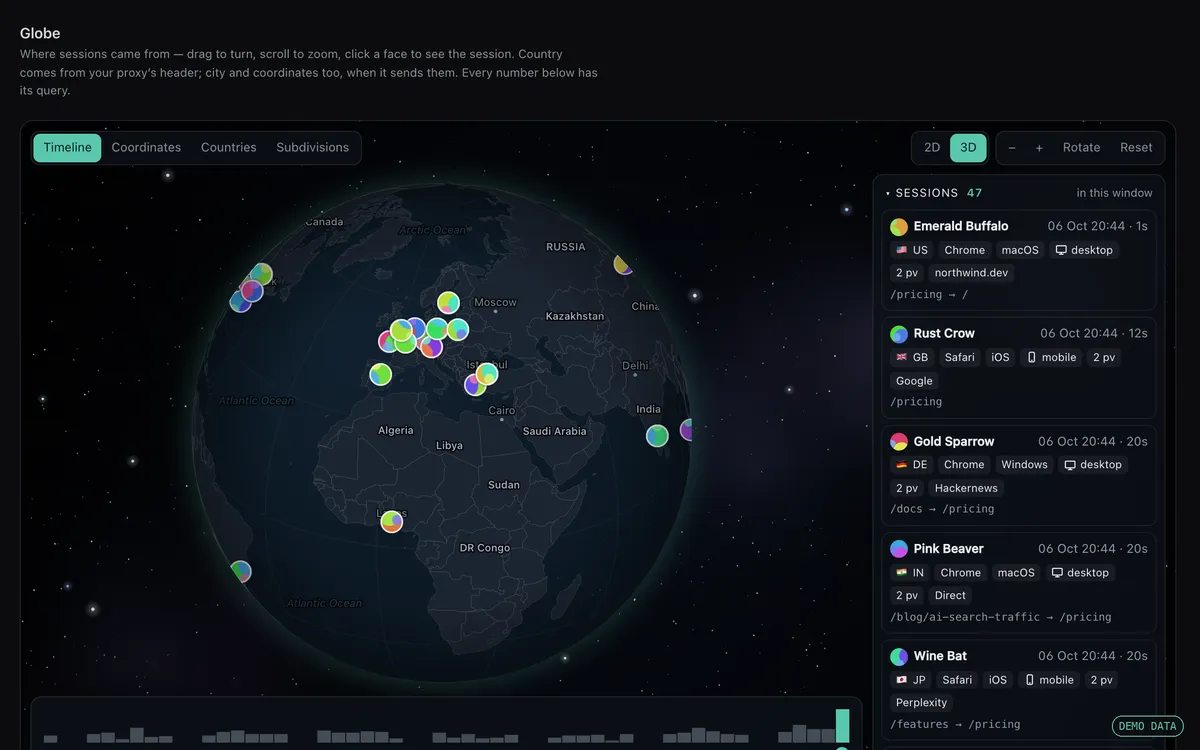
The real globe from the dashboard · demo workspace
Cookie-freeSQL behind every numberApache-2.0One processMCP built inAI-agent awareCookie-freeSQL behind every numberApache-2.0One processMCP built inAI-agent aware
No consent bannerSelf-hosted or cloudOne SQLite fileZero dependenciesWeb Bot AuthNo telemetryNo consent bannerSelf-hosted or cloudOne SQLite fileZero dependenciesWeb Bot AuthNo telemetry
01The proof
Every number opens the query that made it.
This is the product, not a drawing of it. Click a figure on any page and the SQL,
its parameters, the window and the result are right there — the same evidence our AI summary is checked against.
app.vitrus.dev/app
Screenshots are of the shipped dashboard running on a demo workspace, and say so on
the image itself — the figures are sample data, not a customer's.
Open that workspace yourself →
02Portfolio
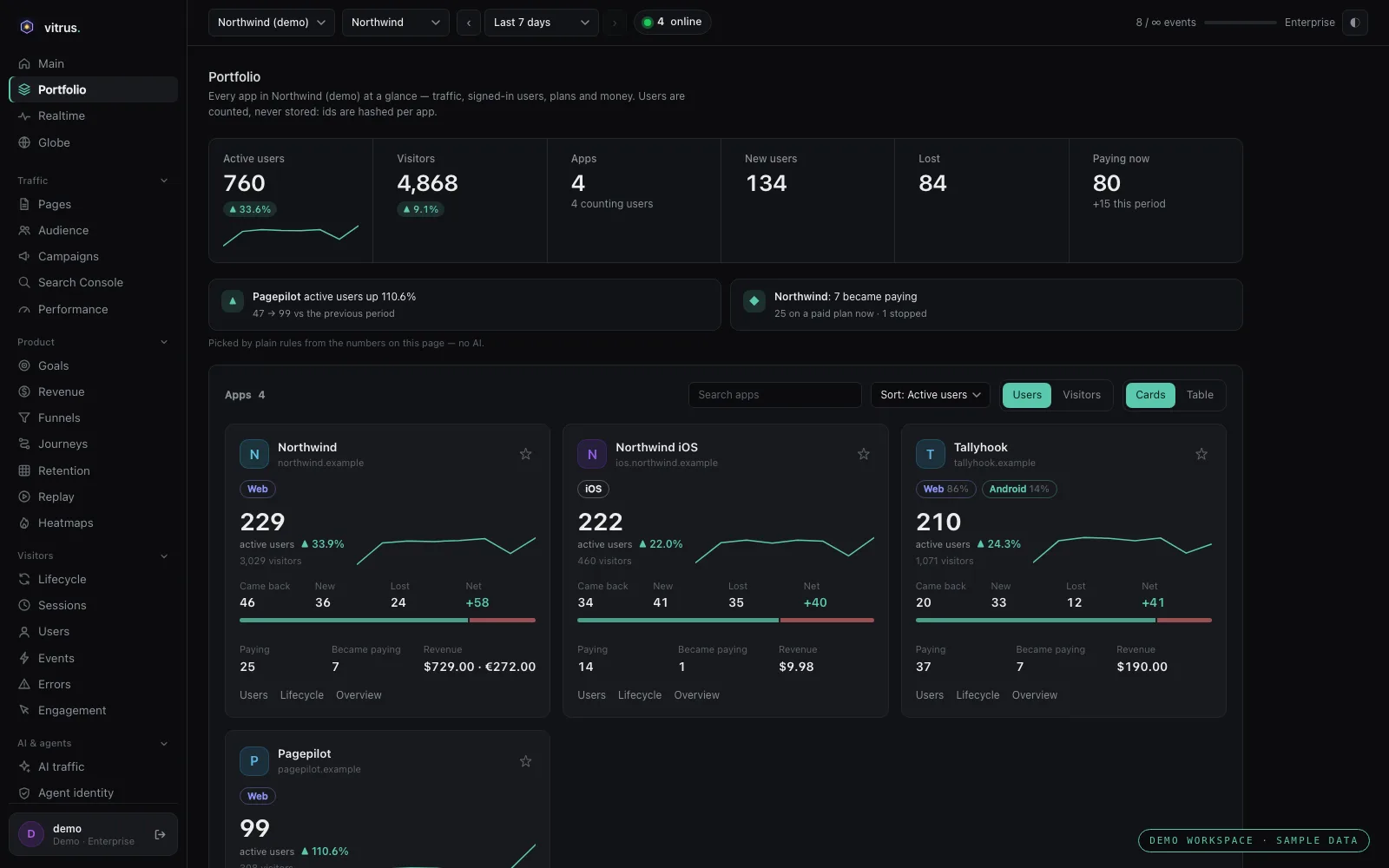
Every app you ship. One panel.
Built five apps with AI this year? Stop opening five admin pages to see who signed up. Add one
line where your app knows the user is signed in, and Vitrus counts who is new, who came back, who you lost and
who started paying — for every app, side by side, web and mobile.
vitrus.identify(user.id) // hashed in the browser, never sent raw
app.vitrus.dev/app?page=portfolio
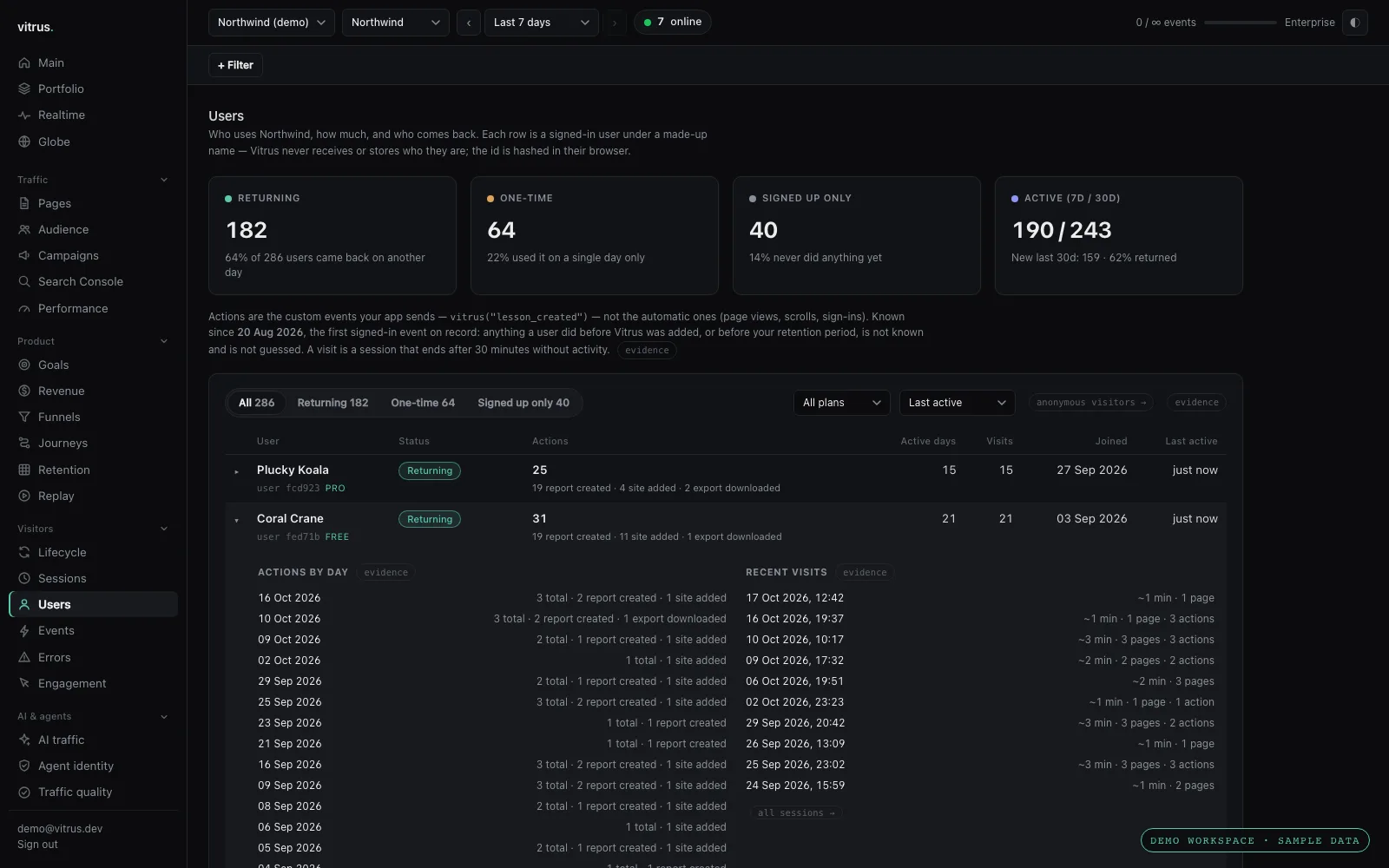
Every user — under a made-up name
Open any app and see each signed-in user: returning, one-time or signed up only, their actions, active days and
visits — as “Amber Falcon”, because there is no email or name on our side to show.
Hashed before it leaves the browser
The script sends sha256(site + id); the server hashes that again with a secret.
Your users' ids — often emails — never reach our servers.
Separate per app, by design
The same person in two of your apps is two unrelated hashes, so nobody — us included — can join them.
Email, phone and name fields are dropped in the browser and again on the server.
app.vitrus.dev/app?page=people
Plus a Lifecycle page per app — new, came back, lost, net, one-and-done, became paying — and every
number on all three pages opens its query. Ask ChatGPT or Claude over MCP and they answer from the same numbers.
Two optional calls make it sharper: vitrus("signup") and
vitrus("plan", { plan: "pro" }). No auth provider to connect, no admin keys handed over.
Open the portfolio in the demo → · How it is counted
03Inside
Twenty views. One file underneath.
Real-time, a 3D globe, sessions, funnels, journeys, goals, revenue, retention and Web
Vitals — all in one process and one SQLite file. Click a number, read the SQL that produced it.
Numeric guardan AI sentence with an unproven number is dropped
SQLite · one file
VITRUS, A SINGLE BUN PROCESS
What changed
Two things broke at once.
The audience stopped being only human, and the reporting stopped being only written by people.
Most analytics tools were designed before either happened.
01
Measurement broke
ChatGPT, Perplexity and Claude send real visitors — and roughly 70% of them land in GA4's
“direct” bucket. Meanwhile GPTBot and ClaudeBot read your pages every day and
most tools either ignore them or count them as people. Worse, those crawlers do not run
JavaScript, so a browser script cannot see them at all —
ours included, until you forward them from your server.
02
Trust broke
Every analytics product is bolting an AI on top that writes your summaries. Those sentences
look authoritative and cannot be checked. When a model writes the report — and increasingly
when an agent reads it — “can I verify this number?” stops being pedantic
and becomes the whole question.
Vitrus is built for both halves: it separates AI referrals from AI crawlers,
and it refuses to publish a number it cannot prove — to you, or to your agent.
Platform
Everything you need to understand your website.
Most teams bolt a traffic tool, a funnel tool and an AI plugin together, then try to
reconcile the numbers. Vitrus brings acquisition, behavior and conversion into one
place — and ties every one of them to evidence.
Acquisition
Where traffic actually comes from. Channels, referrers, campaigns — and AI assistants as a channel of their own.
Behavior
What people do once they land. CTAs, scroll depth, field-level form abandonment, rage clicks.
Conversion
Where you lose them. Ordered funnels show the drop at every step; retention shows who comes back.
Only here
Proof
Every number carries the query that produced it, and you can click it. Unprovable sentences never ship.
If you are moving from Google Analytics, Plausible or Umami, this is the checklist. Every item
is in every plan, including the free one; how many sites and teammates grows with the plan.
Traffic
Pageviews, sessions, unique visitors
Live visitors, right now
Top pages, entry and exit pages
Referrers, channels, UTM campaigns
Devices, browsers, OS, screens, languages
Country, region and city (from your proxy's headers)
iOS and Android apps, with the Swift and Flutter SDKs
Behaviour
Signed-in users, new, came back, lost and paying
Custom events, from code or an HTML attribute
Outbound clicks and form submissions
Field-level form abandonment
Rage clicks and scroll depth
Ordered funnels
Retention cohorts
Health
Core Web Vitals at p75, from real visits
Slowest pages, ranked
JavaScript errors, grouped
Errors by browser and OS
Release tagging for deploy correlation
Control
Many sites and apps, one Portfolio, teams and roles
Exclude your own visits in one click
Skip or mask private URLs in the browser
Standard and strict privacy modes
Slack, email and webhook digests
REST API and a read-only MCP server
Deliberately absent: ad-platform attribution. Session replay exists, but it is off by default
and masked by default. Here is why.
Proof
There is a query behind every sentence
Below is a digest in the shape the product actually produces. Click an
e# badge: what opens is not an explanation — it is the query
that produced the number. The queries are the real ones; the figures are an example, and
saying so is the least a product with this claim can do.
weekly digest · last 7 daysdeterministic · works without an LLM
summary40 unique visitors and 39 pageviews in the last 7 days.
ai16 sessions came from AI assistants — about 40% of all sessions. Mostly perplexity (9 sessions).
funnelMost form abandonment happened on the “phone” field — 6 people stopped there.
Query that ran
SELECT COUNT(DISTINCT visitor_id) AS value
  FROM events
 WHERE site_id = ? AND ts >= ? AND ts < ? AND bot_kind = ''
Parameters
["demo", 1789003421000, 1789608221000]
Result
40 (previous period: 44)
Query that ran
SELECT source, COUNT(DISTINCT session_id) AS sessions
  FROM events
 WHERE site_id = ? AND ts >= ? AND ts < ? AND bot_kind = '' AND channel = 'ai'
 GROUP BY source ORDER BY sessions DESC
SELECT json_extract(props,'$.field') AS field, COUNT(*) AS abandons
  FROM events
 WHERE site_id = ? AND ts >= ? AND ts < ? AND bot_kind = '' AND name = 'form_abandon'
 GROUP BY field ORDER BY abandons DESC
Fixed queries run first and produce an evidence bundle. The model only sees that bundle, and it is forbidden from doing arithmetic.
Unprovable sentences are dropped
Every number in the output is matched against the evidence set. No match, no sentence — it is discarded, not corrected.
At worst, it adds nothing
If the model is unreachable or invents something, we fall back to the deterministic text. An LLM can enrich this product; it cannot break it.
a sentence the guard threw away
“Conversion rate jumped 41.7% to an all-time high.” ↳ 41.7 is not in the evidence set — sentence dropped, digest marked incomplete.
Acquisition
Where your traffic really comes from
The first tool that actually measures AI traffic
Roughly 70% of AI referrals land in GA4's “direct” bucket:
ChatGPT appends utm_source to outbound links, but Gemini and
Perplexity mostly do not. On top of that, most tools lump the bot that reads you
together with the human it sends.
AI referral — a chatgpt.com referrer is a real visitor
AI crawler — GPTBot, ClaudeBot, PerplexityBot read your pages, they bring nobody
Which of your pages get read — the only real feedback loop for GEO/AEO work
A 41-case golden set verifies the classifier at 100% on every CI run
Channel
Sessions
AI assistant ●
16
Search
54
Social
31
Direct
22
Separately: GPTBot made 148 requests — not counted as visitors.
What you get out of the box
One line of script. Pageviews, sources and channels, UTM campaigns, entry and exit
pages, country, device, browser, language. None of it needs extra code.
Time-series chart and a live visitor counter
Visit duration, pages per session, bounce rate
Custom events — with data-vitrus-event-*, no code required
Steps are counted in order: a step must happen after the one before it.
Unordered counting treats someone who signs up and then reads the pricing page as a
conversion, and inflates the funnel. You define the steps; your first funnel works
with no configuration at all.
Home
142 · 100%
Clicked CTA
85 · 60%
Signed up
28 · 20%
Biggest loss at Clicked CTA: 57 sessions.
Session replay is opt-in — and most questions don't need it
Recording someone's screen can mean recording the ID number they typed into your form, so
replay is off until you switch it on, every text node and input value is masked in the
browser, and password and card fields are never captured. Most of the time the cheaper,
privacy-preserving signals answer the question first.
Field-level form abandonment — the field name is sent, never its value
Rage clicks — a sign that an element isn't responding
Scroll depth — aggregate, never per person
Form field
Abandons
phone
61
company
18
email
4
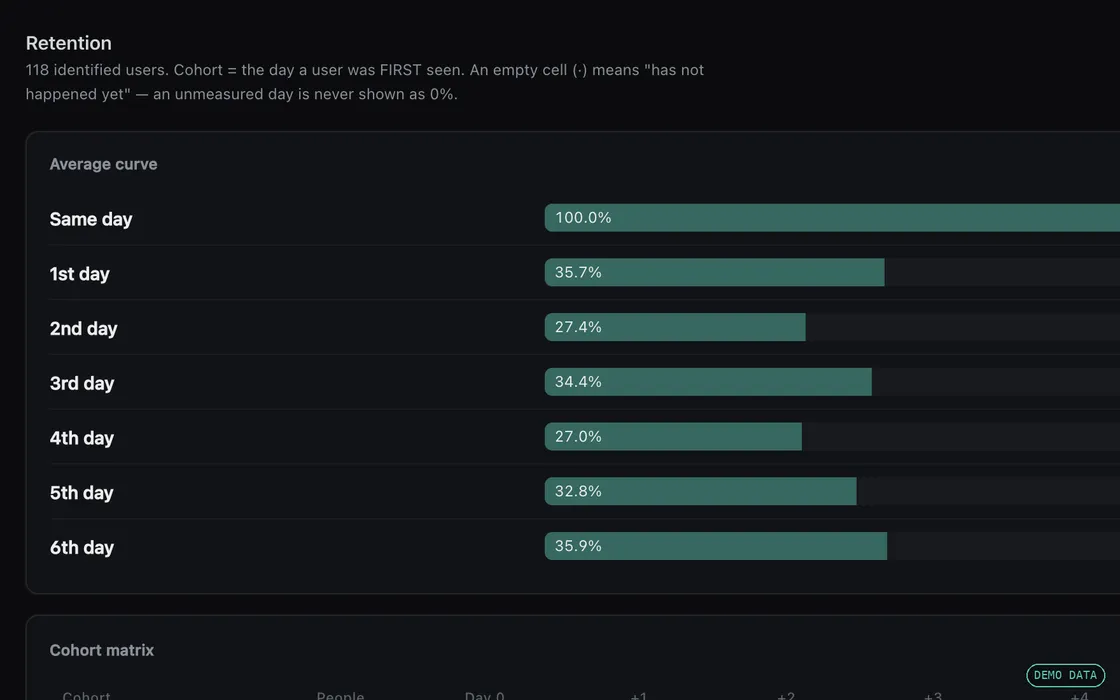
Retention that admits when it can't
Our visitor id rotates daily (we use no cookies), so cross-day tracking of anonymous
traffic is mathematically impossible. Most tools solve this with a persistent
identifier or quietly count it wrong. We took a third route:
we say we can't, and we open the route where we can.
Call vitrus.identify() and the cohort matrix is computed for real
The id is hashed one-way; the raw value never touches disk
A day that hasn't happened yet is never shown as “0% returned”
Cohort
Day 0
+1
+2
+3
Sep 08
100%
42%
31%
28%
Sep 09
100%
38%
29%
·
Sep 10
100%
45%
·
·
· hasn't happened yet — an unmeasured day is never rendered as zero.
Proactive
The summary comes to you
Slack, email, or a plain webhook. Weekly or daily. Three rules hold it together.
Never sent twice
Getting the same weekly summary twice is worse than not getting it. One ledger entry per period.
A failed send is never lost
Network errors are not written to the ledger, so the next tick retries. You don't lose that week.
Empty periods stay silent
No “0 visitors” email for a week with no traffic.
05Agents
Ask your AI. It cites the query.
Connect ChatGPT, Claude, Cursor or Claude Code in a minute. Your assistant reads your
analytics — read-only — and every number it gets back comes with the SQL behind it, so it can
cite instead of assert, and you can check what it told you.
Add the server.https://app.vitrus.dev/mcp as a connector — or one click in Cursor.
Sign in and pick a workspace. OAuth: the app reads that one workspace and nothing else.
Ask. “Which AI assistants sent us people this month, and did they convert?”
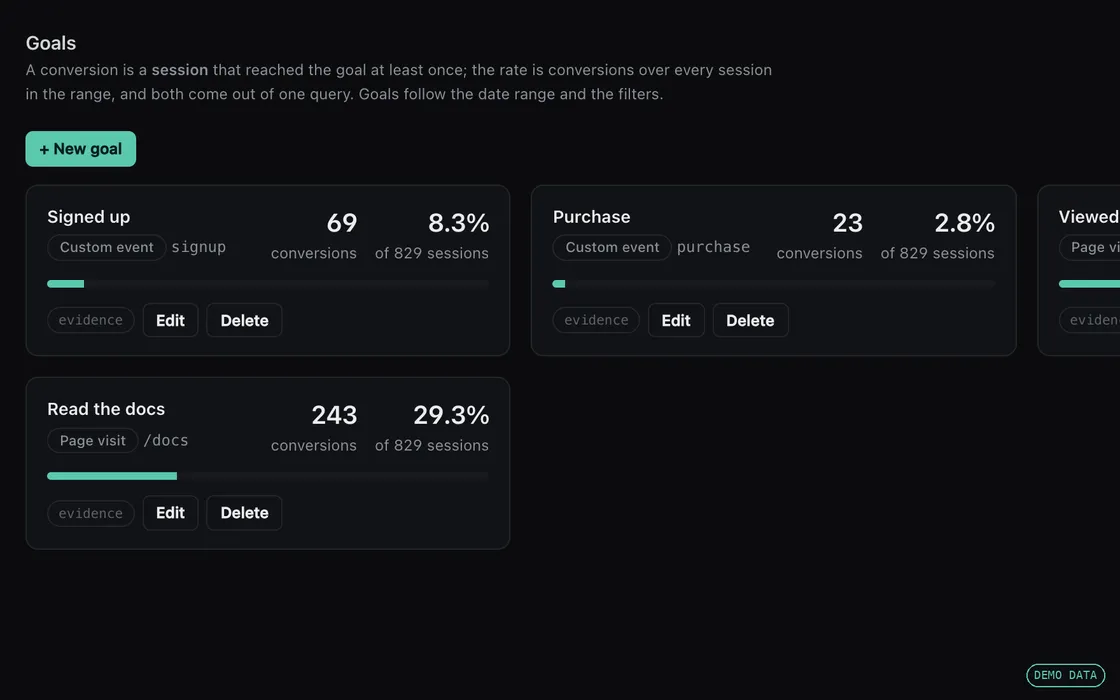
15 read-only tools.Any metric by any of 20 dimensions, real-time, AI traffic, revenue, goals, funnels, journeys, retention, vitals, errors.
Claude Code plugin with four skills.Weekly report, traffic-drop check, measurement plan, AI-search audit — claude plugin marketplace add Vitrus-Dev/vitrus
Yours to cut off.Every connection is listed under Account → Connected apps. Removing someone from the team also ends their apps' access.
ChatGPT sent the most: 188 visitors, then Claude 97, Perplexity 92 and Gemini 43.
Source: SELECT source, COUNT(DISTINCT visitor_id) … WHERE channel = 'ai' AND bot_kind = '' …
AI crawlers (GPTBot, ClaudeBot) are not in these numbers — they read pages but bring nobody.
Real tool output from the demo workspace (sample data). The query is returned with the rows.
Verified identity
“GPTBot visited” means a request said it was GPTBot
Every analytics tool in this category identifies a bot by reading its user-agent — a sentence
the client wrote about itself. We report what a request proved separately from
what it claimed, because that distinction is the whole product applied to bots.
A signature is evidence. A user-agent is a claim.
Web Bot Auth — an IETF draft built on RFC 9421 HTTP Message Signatures — lets an agent
sign its requests. Anthropic, OpenAI, Perplexity and Common Crawl have begun. When a signed
request arrives we check it against the Ed25519 key its operator publishes, and we can name
the signer.
verified — a signature we checked, with the directory that vouched for it
claimed — the user-agent matches a known bot, nothing was signed
human — neither
What this deliberately does not say: an unsigned request is not evidence of anything.
Almost nothing signs yet, and calling unsigned traffic suspicious would replace one
unprovable claim with another.
Label
Requests
verified ●
1,284
claimed
9,610
Example figures. The verified row is the one nobody else can show you —
how it works.
Privacy
No cookies, no consent banner, no persistent id.
The visitor id is a one-way hash that changes every day:
hash(secret_salt + day + site + ip_prefix + browser).
The IP is never stored — it is only an input to the hash.
Works without cookies
No persistent identifier, no retroactive identity stitching. Most sites can drop the banner entirely.
Respects Do Not Track
On by default. A privacy stance that isn't a marketing line should show up in the defaults.
Your data stays yours
Run the open-source core on your own infrastructure, or use the cloud. Either way it is never sold or shared.
Optional
Strict mode
One switch per site drops country, screen size, referrer query strings and cross-day identity — enforced on the server, where the browser script cannot bypass it.
Same for the AI layer: no model is enabled by default. If you turn one on, it's either Ollama
on your own server or your own API key — and what reaches the model is an aggregated evidence
bundle, never raw visitor data.
Compare
How we're different
Most individual features exist somewhere. The bold rows exist nowhere else — and where a rival is ahead of us, we say so below the table.
Checked 24 September 2026 against each product's own documentation (mobile SDKs: 18 October 2026). These
products ship quickly; a comparison table with no date on it is a claim about the present that
quietly rots. If a cell is wrong, tell us and we will fix it.
Capability
Umami
Plausible
Rybbit
Databuddy
Vitrus
Cookie-free, no consent banner
✓
✓
✓
✓
✓
Self-hostable
✓
✓
✓
✓
✓
Services to install
Postgres
PG + ClickHouse
PG + ClickHouse
PG + CH + Redis
none · one SQLite file
Daily salt on the visitor id
✓
✓
optional, off by default
—
always on
Funnels, journeys and goals
✓
✓ (funnels on paid plans)
✓
✓
✓
Proactive digest (arrives unasked)
—
alerts
✓
✓
✓
AI usage metered separately
no
no
no
yes, credits
never
Local LLM / bring your own key
—
—
—
—
✓
Session replay
✓
—
✓
—
opt-in, masked by default
Official Swift (iOS) and Flutter SDKs
community only
Events API
React Native only
HTTP API
✓
All your apps in one panel: users, plans, revenue
—
—
—
—
✓
User ids hashed in the browser, never stored raw
—
no user ids
salting off by default
—
✓
Clickable query behind every number
—
—
—
—
✓
Unprovable AI sentences auto-dropped
—
—
—
—
✓
Where others are ahead of us today. Umami has
attribution reports and custom boards; Plausible imports Google Analytics history, and Rybbit imports Plausible exports (we import
from Umami only); and both run on databases built for far larger volumes. If one of them is what you
need, pick that tool.
Pageviews and custom events count the same. AI messages are not metered —
the digest is deterministic anyway, so rationing it would be artificial scarcity.
Going over the limit does not cut you off: data keeps flowing inside a 20%
grace band with a warning in the dashboard. Analytics you failed to collect never comes back.
Every metric is defined as a fixed SQL query. When a digest is produced those queries run and
their results are stored as evidence records. Click a number in the dashboard and you see the query
that ran, its parameters and the raw rows. An LLM may rephrase that bundle but cannot produce a new
number — the moment it does, the output gate drops the sentence.
Do you store my users' emails or names?
No — and not because of a setting: the data never reaches us. When your app calls
vitrus.identify(user.id), the script hashes the id in your user's browser before
anything is sent; the server hashes it again with a secret and stores only that. Email, phone, name, address and
similar fields are dropped in the browser and again on the server. The Users page shows each person under a
made-up name such as “Amber Falcon”, so you can follow someone's activity without anyone learning
who they are — and the same person in two of your apps cannot be linked, by us or by anyone.
Can my AI assistant tell me how all my apps are doing?
Yes. Connect ChatGPT, Claude, Cursor or Claude Code over MCP and ask “which of my apps lost the most users
this week?”. get_portfolio and get_lifecycle answer with
counts only — no list of people — and the query behind each number, so the assistant cites instead of guessing.
Does my data go to an LLM provider?
Not unless you want it to. No model is enabled by default; the digest is generated deterministically.
If you turn one on you have two options: Ollama on your own server (data never leaves the box) or your
own API key. In both cases what reaches the model is an aggregated evidence bundle, not raw visitor data.
How do you count unique visitors without cookies?
A one-way hash built with a secret salt that rotates daily:
hash(salt + day + site + ip_prefix + browser). The IP is never stored, it is
only an input. The next day the same person hashes to a different value; there is no persistent identifier.
Is there session replay?
Yes, and it ships the other way round from most tools. Recording a visitor's screen can mean recording
the ID number they typed into your form — if masking misses one field, you created your customer's
compliance problem. So replay is off by default, a page has to opt in, every text node and input value is
masked unless you unmask an element on purpose, password and card fields are never captured, and Do Not
Track always stops it. Field-level form abandonment, rage clicks and scroll depth still answer most of the
same questions without recording anyone.
Can I run it on my own server?
Yes — the core is Apache-2.0. One process, no second service to install (the database is embedded).
The cloud version takes on team management, quotas and hosting; the engine is identical and no feature is
held hostage.
Can it replace GA4?
For most sites, yes. Not for ad-platform attribution (Google/Meta Ads ROAS) — we deliberately don't do
that. The question Vitrus answers is “where is my traffic coming from, where do people drop off, and
is this number correct?”
Don't trust the dashboard. Check it.
One line to install. First digest a week later. Or look around first — the demo needs no account.